 RatedDays
Year in Review Ideas: Questions, Formats and a Plan for Looking Back on Your Year
Most year in review ideas online are about making something to post: a photo dump, a recap reel, a collage. Those are fun. But if you want the review to change anything about next year, you need two more things first: an honest picture of what happened, and a few good questions to ask about it.
This guide gives you both, plus eight formats to keep the result in. It's November, so you also have something most December reviewers don't: time to notice what's missing and do something about it before the year ends.
Step 1: Rebuild the year before you reflect on it
Memory is a bad record of a year. It holds onto the peaks, the very end, and whatever happened last week. Psychologists call one version of this the peak-end rule: we judge an experience mostly by its most intense moment and how it ended, not by its overall length or average. A hard December can make a mostly good year feel bad, and the reverse.
So gather evidence first. In order of usefulness:
- Your own daily record. A journal, a one-line-a-day notebook, a mood tracker or a year in pixels. If you have one, this is gold.
- Camera roll. Scroll month by month. Favorite 3 to 5 photos per month.
- Calendar. Trips, birthdays, appointments, first and last dates of things.
- Messages. Search for "congrats," "happy birthday," "I'm so sorry." You'll find the big moments fast.
- Bank statements. Where you spent shows what you prioritized: concerts, flights, takeout, a gym you stopped going to.
Write a rough list: month name, then two or three things that happened. Twelve short lines. That list is the raw material for everything below.
How to use a year of daily ratings or notes
If you rated or noted your days, you can answer questions that memory can't. Spend ten minutes on these:
- Count. How many great days, how many bad ones, how many ordinary? Most people find far more ordinary days than they'd guess, and fewer bad ones.
- Average by month. Which month was actually your best? It's often not the one with the vacation.
- Find your top ten days. Read what you wrote on them. Who was there? What were you doing? Look for repeats.
- Find your bottom ten. Same question. Were they caused by events, or by sleep, work, or a particular situation?
- Spot streaks. Your longest good stretch and your longest low patch, and what started and ended each.
- Check what lifts and drags. If you tagged days (gym, late night, family, deadline), compare the average rating with and without each tag.
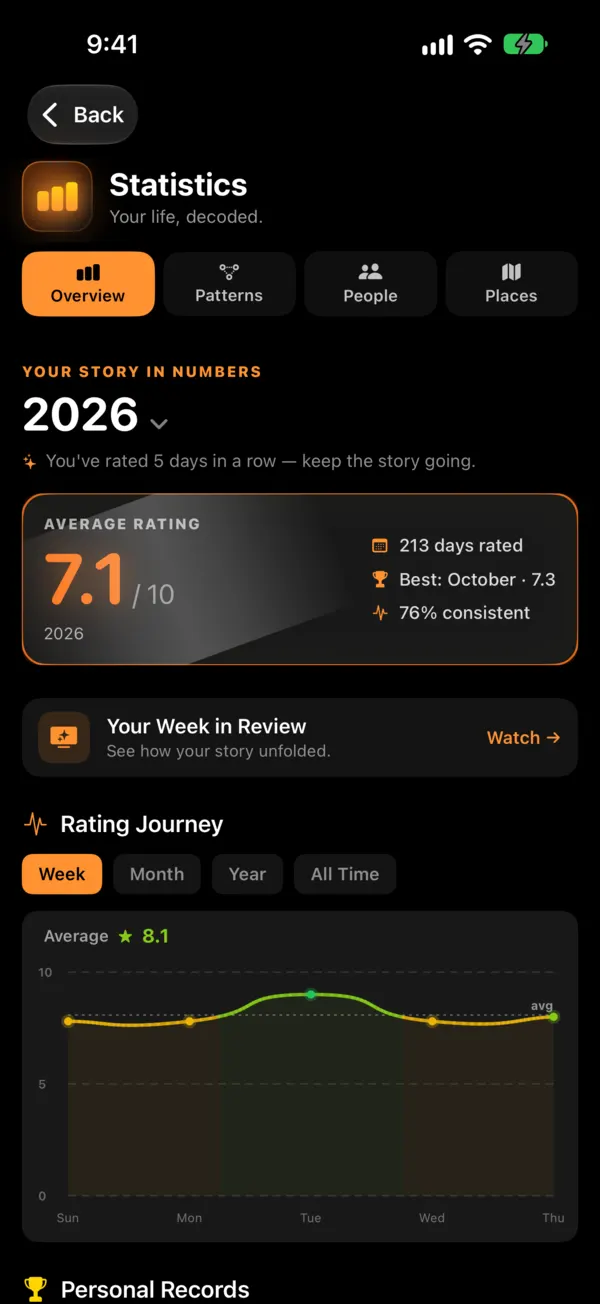
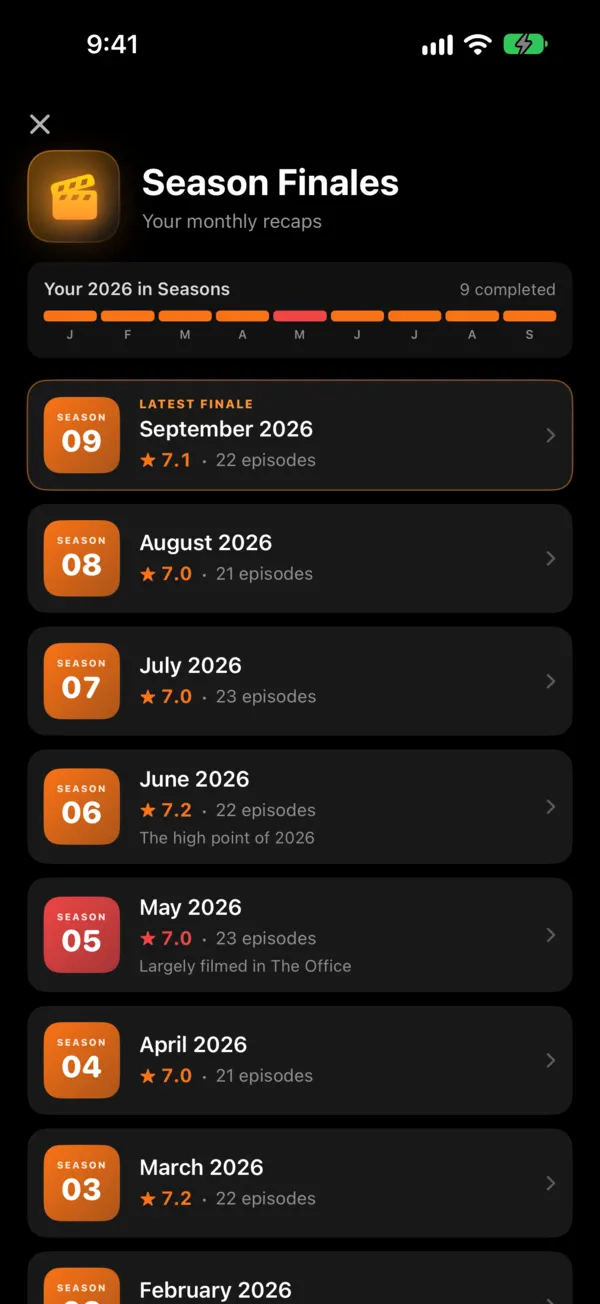
This is the part apps do well. In Rated Days, where you rate each day out of 10 and add tags and people, the statistics view shows which tags lift or drag your days and ranks your people by how good your days with them are, and each month ends with a Season Finale summary you can reread in December.
Step 2: Ask the right questions (40 to choose from)
Don't answer all forty. Pick ten that make you pause, and write at least two sentences for each.
Highs
- What was the single best day of the year? What made it good?
- What moment would you relive exactly as it was?
- What did you do this year that you're proud of, even if nobody noticed?
- When did you laugh hardest?
- What small, ordinary thing made the year better? (A walk, a show, a coffee spot.)
- What surprised you in a good way?
- What did you finally do that you'd been putting off?
Lows
- What was the hardest moment, and how did you get through it?
- What kept coming back as a problem?
- What took more energy than it was worth?
- What did you avoid that you knew you should face?
- What would you do differently if you got this year again?
- What did you lose this year, and have you let yourself feel it?
People (your cast)
- Who were the five people you spent the most time with?
- Who made your days better without trying?
- Who did you grow closer to? Who drifted?
- Who did you meet this year that you're glad you did?
- Who do you owe a thank-you message to? (Send it this week.)
- Whose company drained you, and what will you do about it?
Change and growth
- What three words describe this year?
- What did you change your mind about?
- What new habit stuck? What habit quietly died?
- What did you learn that you'll use for the rest of your life?
- What were you afraid of in January that turned out fine?
- How are you different from who you were twelve months ago?
- What did you say no to, and was it the right call?
Body, time and money
- How was your sleep, honestly?
- What did your body tell you this year?
- Where did your free time actually go?
- What was your best purchase? Your worst?
- What did you consume most: books, shows, podcasts, scrolling?
Looking forward
- What do you want more of next year?
- What do you want less of?
- What's one thing you'll stop doing on January 1?
- What would make next year a 9 out of 10?
- What's one thing you want to have done by next December?
- What will you try just to see what happens?
- What do you want people to say about how you showed up?
- What does a great ordinary day look like for you?
- If this year was a TV season, what would its title be?
That last one is more useful than it sounds. Naming a year forces you to decide what it was about. If you like it, our guide to treating your life as a TV series takes the idea further.
Step 3: Pick a format (8 year in review ideas)
The format is where it becomes something you'll keep. Choose one that fits how much time you have.
1. Month-by-month list (30 minutes). Twelve headings, two or three lines each. The simplest and most rereadable. Add a one-word mood to each month.
2. Your personal "Wrapped" (1 hour). Borrow the streaming-recap format: your top 5 people, top 5 places, top song, most-watched show, number of new things tried, best day, longest streak. Numbers make it fun; daily data makes it accurate.
3. Twelve photos, twelve captions (1 hour). One photo per month with a single sentence. Works as a private album, a printed page or a post.
4. Superlatives (30 minutes). Award the year: Best Day, Best Meal, Best Trip, Best New Person, Most Overrated Plan, Biggest Plot Twist, Comeback of the Year.
5. The season finale recap (1 hour). Write it like the "previously on" before a finale: the main storylines, the cast, the turning points, the cliffhanger you're carrying into next year. Surprisingly good for seeing your year as a whole.
6. A letter to next year's you (45 minutes). Tell them what happened, what you hoped for, what you're worried about. Seal it and open it next December.
7. Top 10 days (1 hour, needs daily records). Rank your ten best days and write a paragraph on each. Then look at what they share. This is the most useful format for planning next year.
8. The one-page review (2 hours). Wins, lessons, people, numbers, three goals, all on one page. Print it and put it where you'll see it in March, when resolutions usually fade.
Mistakes that make year in reviews useless
- Only listing achievements. A review of wins is a resume. The lows teach you more.
- Judging the year by December. Remember the peak-end effect. Check the whole record before deciding it was a bad year.
- Setting fifteen goals at the end. Pick one to three. You'll actually remember them.
- Doing it alone in your head. Write it down. Thinking it through is pleasant; writing it is what you can reread next year.
- Skipping it because the year was hard. Hard years are the ones where the review matters most. If this year left you struggling, a review isn't a replacement for support: talk to a doctor or someone you trust, or in the US call or text 988.
Start now, finish in December
Because it's November, try this: answer five of the questions above tonight. Then, for the rest of the year, rate or note every day, even in one line. On December 31 you'll have six weeks of real data to go with your memories, and a head start on next year's review. A quick weekly reflection in the meantime makes the final review even easier.
Frequently asked questions
When should I do my year in review?
Any time from late November to mid-January works. Starting in November means you can still notice what's missing and finish the year differently. Many people block one quiet evening between Christmas and New Year, then add a short follow-up once the year has fully ended.
How long does a personal year in review take?
A quick version takes about an hour: twenty minutes gathering, twenty answering questions, twenty choosing a format. A deep version can fill a weekend. If you kept daily notes or ratings, gathering is much faster because the year is already written down.
What if I don't remember much about my year?
Use what your phone remembers: scroll your camera roll month by month, then your calendar, messages and bank statements. Those four sources rebuild most of a year in under an hour. Next year, a one-line daily note or a quick day rating saves you the dig.
What are good year in review questions?
Start with highs and lows (best day, hardest moment), then people (who mattered most), then change (what you started, stopped, learned), then forward (what to keep, drop and try). Pick ten from the list here rather than answering all forty.