 RatedDays
Your Life as a TV Series: Episodes, Seasons, Finales and Your Cast
"If my life was a TV show, what would this episode be called?" It's a question people ask as a joke, and it turns out to be one of the most useful ways to look at your own days.
Treating your life like a TV series gives ordinary time a structure it doesn't naturally have. Days become episodes with titles. Months become seasons with arcs. The people around you become your cast. And at the end of each season, you write a finale, so the month doesn't just disappear into the next one.
This page explains the idea, why it works, and exactly how to do it, with title formulas, a rating guide, season arc examples and finale questions you can use tonight.
The idea: your days are episodes
TV gives us a shared language for time. Everyone knows that a season has a premiere and a finale, that there are filler episodes and great ones, that a character can have a rough arc and come back from it, and that a single bad episode doesn't ruin a show.
Mapped onto your life:
| TV series | Your life |
|---|---|
| Episode | One day |
| Episode title | The one thing you'll remember about that day |
| Episode rating | How the day went, 0 to 10 |
| Season | One month (or a life chapter) |
| Season arc | What that month was about |
| Season finale | Your end-of-month look back |
| Cast | The people in your days |
| Sets | The places you spend time |
| Genre | The kind of day: comedy, drama, slice of life, thriller |
| Series | Your whole life so far |
Using the calendar is the simplest way to number it. If each month is a season, then November 3 is Season 11, Episode 3, or S11 E3. Every day already has its place in the show.
You've probably seen the internet version of this: "main character energy," "villain arc," "this is my healing era," "new season, new me." Those phrases stick because the structure is useful. The difference here is that you're not posting it. You're keeping a record.
Why the TV-series framing helps
You already think in stories
Psychologists who study narrative identity argue that people make sense of who they are through an internal, evolving life story, and that how we tell that story, for instance whether setbacks lead somewhere, is linked to well-being (McAdams & McLean, 2013). The TV-series framing gives that story a practical shape you can fill in a few seconds a day.
One bad episode isn't the whole show
When a day goes badly, it can feel like everything is going badly. Seeing it as one episode in a season of thirty changes that. Even great shows have a 4.5 episode. You rate it, title it, and move on to the next one.
Filler is allowed
Most episodes of most shows are neither the best nor the worst. The same goes for your days. Knowing that a 6.2 is a normal, perfectly fine episode takes the pressure off needing every day to be special.
It gives you a little distance
Describing your day as an episode puts you half a step back from it, like a viewer instead of someone in the middle of it. "The One Where the Meeting Ran Over and I Snapped at My Sister" is easier to look at honestly than a vague feeling that today was bad.
Seasons need endings
Months usually blur together. A season finale forces a stop: what happened, who mattered, what changed. Twelve finales a year means you never get to December wondering where the year went.
How to treat your life like a TV series
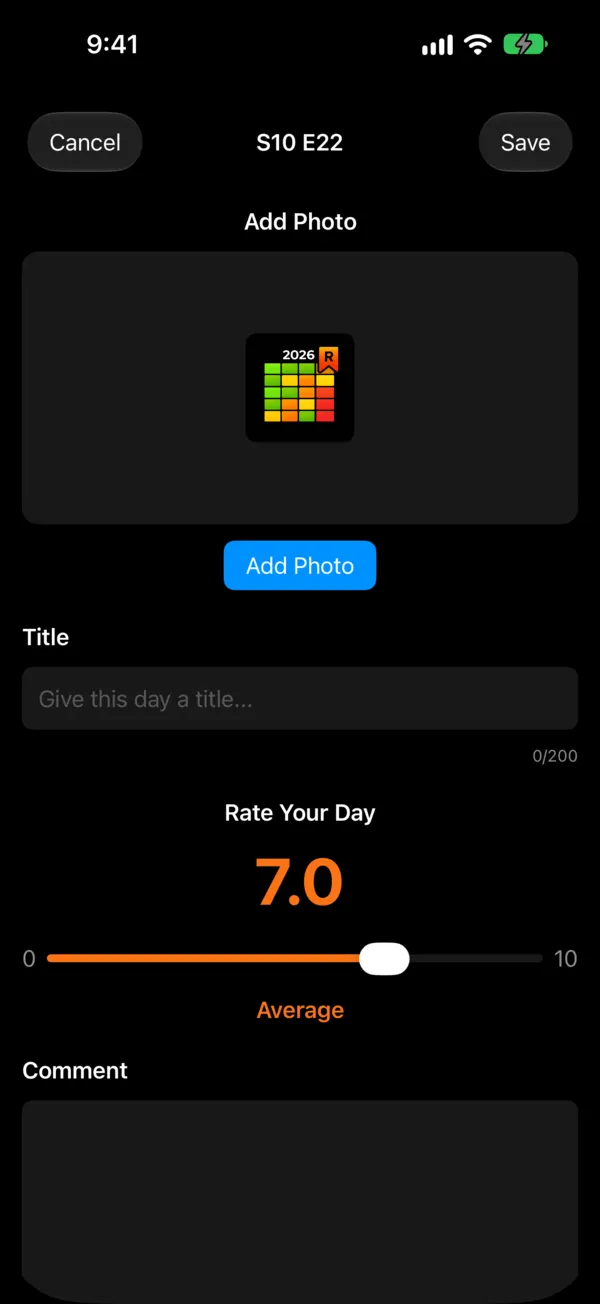
1. Rate each episode from 0 to 10
Score the whole day, the way you'd rate an episode of a show you love. Use one decimal so you can tell a 6.8 from a 7.4.
- 9 to 10: an all-timer, the episode people would rewatch
- 7 to 8.9: a strong episode, good things happened
- 5 to 6.9: a solid, ordinary episode
- 3 to 4.9: a rough one, the plot went against you
- 0 to 2.9: one of the hardest episodes of the series
For more detail on each number, see our guide on how to rate your day out of 10.
2. Give every episode a title
The title is the best part. It's what turns a number into a memory. Formulas that work:
- "The One Where…" The classic sitcom format. The One Where Dad Learned to Video Call.
- A short noun phrase. The Flat Tire. The Interview. Pancake Sunday.
- A line someone said. "We Should Do This More Often."
- The place. Gate 22. The Corner Booth.
- The cold open. Name the day after how it started. The 5 a.m. Alarm.
Rule of thumb: title the day after what you'll remember a year from now, not what took the most time. A day spent mostly working, with a great dinner at the end, is The Dinner.
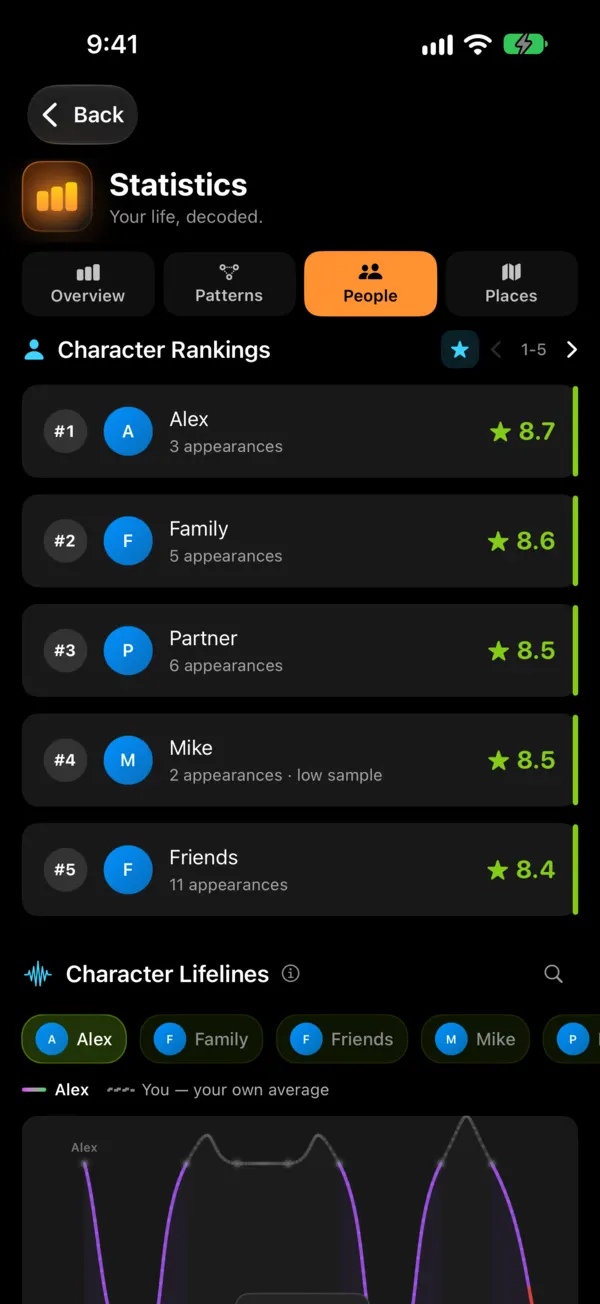
3. Track your cast
Write down who appeared in each episode. Over time you'll see three groups:
- Main cast: in most episodes. Partner, roommates, family, close coworkers.
- Recurring characters: show up every week or two.
- Guest stars: a visiting friend, someone new you met, a stranger on a train who made your day.
Once you've rated enough episodes, you can see which cast members appear in your best episodes. That's not about ranking people; it's about noticing who you should make more time for.
4. Note the sets and the genre
Where did the episode happen, and what kind of episode was it? A comedy day, a drama, a quiet slice-of-life, a thriller with a deadline. After a few weeks, patterns appear: maybe your best episodes are filmed outdoors, or your dramas all happen on Sunday nights.
This is exactly what Rated Days is built around. Each day is an episode with its own number (S11 E3), a 0 to 10 rating, a title, and your cast, places, genre, tags, photos and a note. Every week a Narrator's Cut recaps your episodes like a TV narrator, and every month ends with a Season Finale.
5. Plan a season arc
At the start of a season, decide what you'd like it to be about. One sentence. Examples:
- The Comeback Season: recovering from a hard few months, sleep and walks first.
- The Winter Arc: quieter, focused, getting stronger before spring. (Our winter arc tracker guide covers this one.)
- The Social Season: say yes to more plans, see one friend a week.
- The Building Season: shipping a project, learning a skill.
- The Rest Season: permission to do less on purpose.
Then pick one or two habits that serve the arc, and watch whether the episode ratings follow. An arc doesn't have to go to plan. Plenty of the best seasons of TV went somewhere the writers didn't expect.
6. Do a weekly "previously on"
Once a week, recap the last seven episodes in three or four sentences, the way a show opens with "Previously on…" What were the storylines? Who appeared most? What's left unresolved? This takes five minutes and keeps the season from blurring.
7. Write the season finale
At the end of each month, answer these:
- What was this season's real arc, as opposed to the one you planned?
- What were the three best episodes, and what did they have in common?
- What was the low point, and how did the story move past it?
- Who was the breakout cast member?
- What's the cliffhanger you're carrying into next season?
- What's the title of this season?
Twelve finales give you most of a year in review before December even starts.
Episode title ideas to get you started
Stuck on a title? Borrow one of these and swap in your details:
- The One With the Long Lunch
- The Pilot (first day at anything)
- The Bottle Episode (stayed home all day)
- The Crossover (two friend groups met)
- The Road Trip
- The Plot Twist
- The Quiet One
- The Rain Check
- The Reunion
- The Day Nothing Went Wrong
- The Return (first day back after time away)
- Mid-Season Finale (the last day before a break)
Pitfalls to avoid
Performing instead of living. The framing is for reflection, not for staging days to look good. A slow Sunday that you'd rate 7.5 is a great episode even if nobody would watch it.
Forgetting everyone else is the lead of their own show. "Main character" thinking goes wrong when other people become extras. Your cast has their own arcs, and some of your best episodes are the ones where you were the supporting character in theirs.
Writing a "villain arc" as an excuse. It's fun as a joke; it's not a plan.
Expecting every season to be a hit. Some seasons are about getting through. Rating them honestly is what makes the good ones mean something.
Overproducing. If titling, rating and tagging takes more than a minute or two a day, cut back to the rating and title. Those two do most of the work.
Start with tonight's episode
You don't need a premiere date. Tonight, give today a rating from 0 to 10 and a title. Write down who was in it. That's Episode 1 of the rest of the season, and in a month you'll have a whole season to look back on.
Frequently asked questions
What does it mean to treat your life like a TV show?
It means looking at your life with the structure of a series: each day is an episode with a title and a rating, each month or life chapter is a season with an arc, and the people you spend time with are your cast. The point isn't performing for an audience; it's seeing your own story clearly.
How do you rate your life like a TV series?
Score each day from 0 to 10 the way you'd rate an episode, with decimals allowed. Most days land between 5 and 7, which is normal: every show has filler. Over a month, the ratings form a season graph, and you can see where the season peaked, dipped and turned.
What is a season of life?
A season of life is a stretch with its own theme: a new job, a breakup, training for a race, a newborn, a winter arc. In practice, using calendar months as seasons is easiest, because every month gets a clear start, a finale and a number, while longer chapters show up as runs of seasons.
Is 'main character energy' healthy?
The useful part is taking ownership of your own story and decisions. The unhealthy part is treating other people as extras in it. Everyone in your cast is the lead of their own show. Use the framing to reflect and act on purpose, not to perform or seek attention.
What should I name my life episodes?
Name the day after the one thing you'd remember about it a year from now. Formats that work: 'The One Where…', a short noun phrase ('The Flat Tire'), a line someone said, or a place. Titles should be fast; if one takes more than thirty seconds, use the first idea.