 RatedDays
How to Rate Your Day Out of 10 (and Make the Number Mean Something)
"How was your day, 1 to 10?" is one of the fastest check-ins there is. It takes five seconds, works at the dinner table, and turns a vague feeling into something you can compare. The trouble is that most people's numbers drift. Everything becomes a 7, bad days get rounded up out of politeness, and after a month the ratings say nothing.
This guide fixes that. You'll get a calibrated scale you can actually stick to, a short list of what to record alongside the number, and a realistic picture of what a few months of ratings will show you.
Why rate your day at all?
A single number does something a diary entry can't: it makes days comparable. You can't easily line up thirty journal pages, but you can line up thirty numbers and see that Tuesdays are consistently worse, or that every day you saw a certain friend landed above an 8.
It also gets around a quirk of memory. Psychologists call it the peak–end rule: we judge an experience mostly by its most intense moment and by how it ended, not by the whole thing. Ask yourself in March how November went and you'll remember one awful week and the holidays. Daily ratings, written down while the day is fresh, keep the full record.
A calibrated 0–10 scale for rating your day
The key is anchoring every number to a kind of day, not a feeling in the moment. Here's a scale that works for most people. Adjust the descriptions, but keep the shape: most days should land between 4 and 7.
| Rating | What kind of day it is | How often |
|---|---|---|
| 0–1 | One of the worst days of your life: a loss, an emergency, real crisis | Very rare |
| 2–3 | A genuinely bad day: a fight, bad news, feeling awful most of the day | A few times a month at most |
| 4 | Below par: tired, irritable, things went sideways, nothing terrible | Common |
| 5 | Ordinary: work, errands, dinner, nothing stood out either way | Your most common rating |
| 6 | Pleasant: a small win, a good conversation, a decent workout | Common |
| 7 | A good day you'd happily repeat | Several times a week if life is going well |
| 8 | Very good: something you looked forward to delivered, or a day that just flowed | A few times a month |
| 9 | Excellent: a memorable trip day, a big win, time with people you love at their best | A handful of times a year |
| 10 | Among the best days of your life | Once or twice a year, if that |
Three rules that keep the scale honest
- 5 is normal, not bad. The most common mistake is treating 5 as failing, like a school grade. An ordinary Tuesday is a 5, and that's fine. If 7 becomes your "normal," you've lost half the scale.
- Rate the whole day, not the last hour. Before you pick a number, run through the day from morning to evening in your head. This counters the peak–end effect: a great dinner shouldn't erase a miserable afternoon, and one bad email at 9 p.m. shouldn't sink a good day.
- Compare to your own recent days, not to an ideal. Ask "was this better or worse than yesterday?" before asking "what number is this?" Relative judgments are easier and more consistent.
Should you use decimals?
Decimals help once you've been rating for a few weeks and notice that two "7" days felt quite different. A 6.8 and a 7.4 tell a more accurate story. The rule: decide the whole number first, then nudge with the decimal. Don't spend more than ten seconds on it.
What to note alongside the number
A number on its own tells you how a day went. A few quick notes tell you why, and the why is where the useful patterns come from. Keep it to what you can capture in under a minute:
- One line about why. "Slept badly, meeting ran long, nice walk after." This is the most valuable thing you'll write.
- Tags for recurring factors. Things that happen often enough to compare: gym, late night, worked from home, alcohol, family, rain, deadline. Pick 10–15 and reuse them, rather than inventing new ones each night.
- People. Who you spent real time with. Over months this becomes one of the most revealing columns.
- Place. Home, office, a specific café, a city you visited.
- A title, if you like. Naming the day ("The One Where the Car Broke Down") sounds silly, but titles make old days instantly findable and fun to scroll back through.
Here's what a full entry looks like:
6.4 — "Rainy Thursday, Good Call." Slow morning, rain all day. Long call with Sam that cheered me up. Skipped the gym. Tags: work from home, rain, friends. People: Sam.
That took about forty seconds. Thirty of those will add up to something.
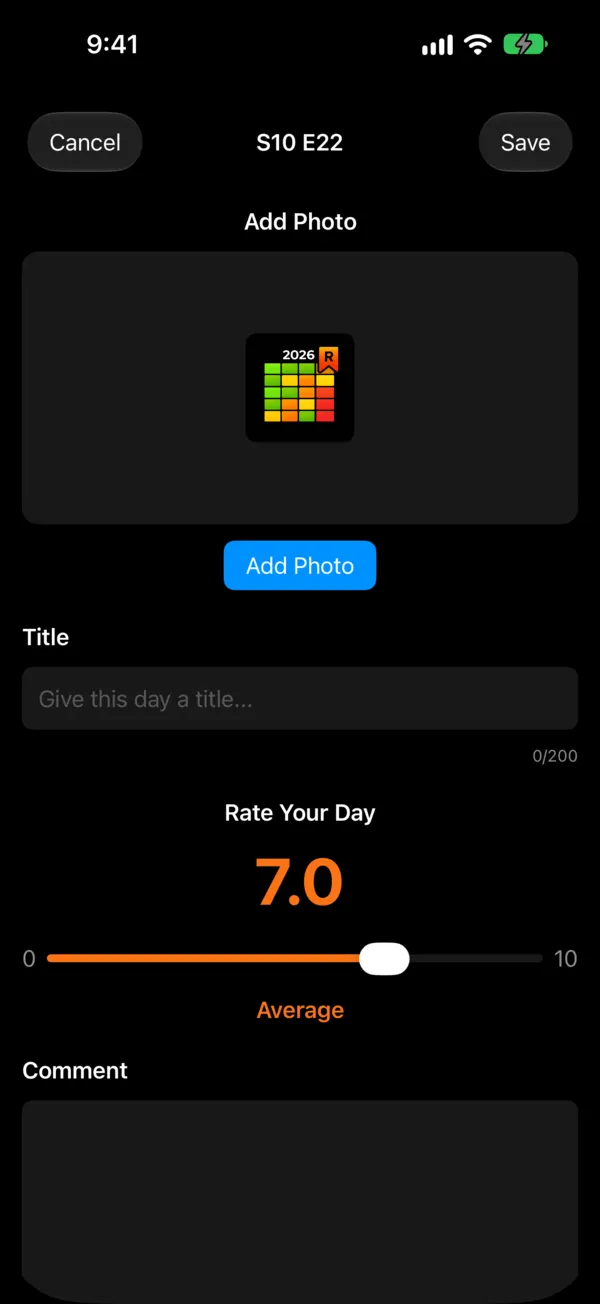
If you'd rather not keep this in a spreadsheet or notes app, this is exactly what Rated Days is built around. Each day is an "episode" you rate from 0 to 10 with a decimal, give a title, and tag with people, places and activities. There's a daily reminder and a Quick Rate widget so the five-second version really is five seconds.
How to make it a habit
Rating your day only works if you do it most days. A few things help:
- Attach it to something you already do at night, like brushing your teeth or plugging in your phone.
- Use a reminder set for when you're usually winding down, not when you're still out.
- Missed a day? Rate it the next morning anyway, as best you can, and move on. A rough rating beats a gap.
- Don't reread every entry while you're building the habit. Just log. The looking-back comes later.
What a few months of ratings reveal
The first week of ratings is mostly noise. Around the one-month mark, patterns start to appear. By three months, you'll usually find a few things you didn't expect.
Your real baseline
If you've used the scale honestly, your average will probably land somewhere between 5 and 7, since that's how the scale is built. It may be lower than you'd have guessed if someone asked "are you happy?" That's not bad news; it's the honest middle of a normal life. Knowing your baseline lets you notice when a stretch drops below it before it becomes a long slump.
What lifts and drags your days
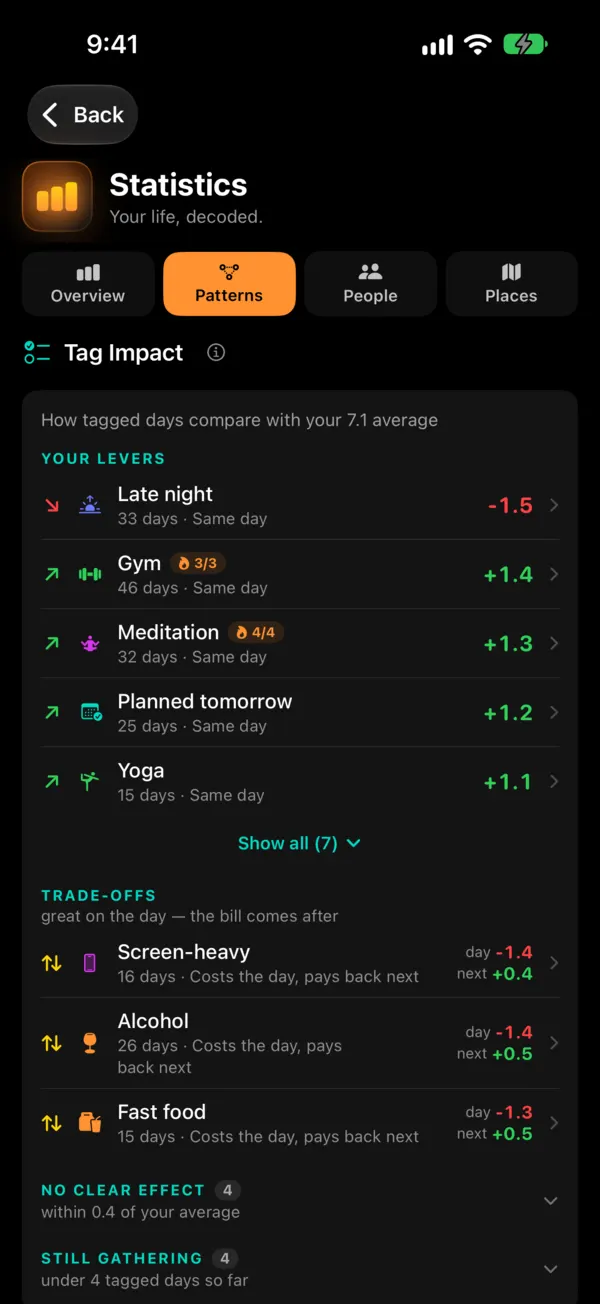
Compare the average rating on days with a tag to days without it. This is where it gets interesting. The kinds of things people discover:
- The habit you assumed mattered most (say, the gym) makes less difference than something boring like sleep or late nights.
- Specific people consistently lift days. Others, gently, don't.
- "Productive" days and "good" days aren't always the same days.
- A small thing, like a walk outside or cooking dinner, quietly shows up on most of your 7s.
Rhythms you didn't notice
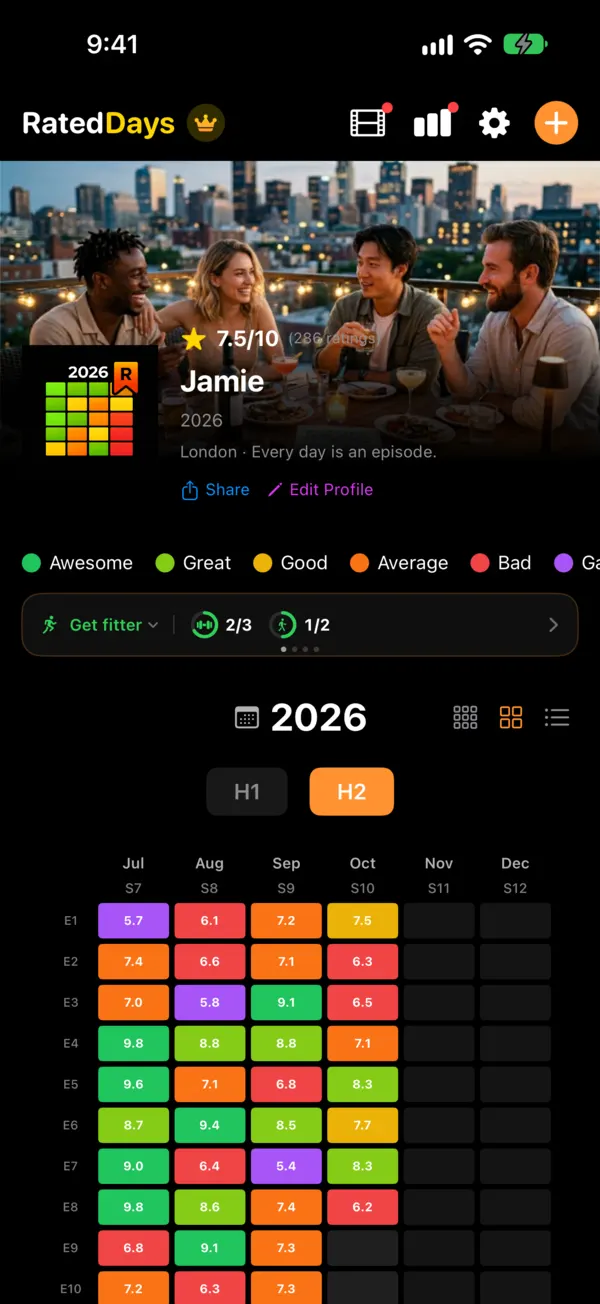
Group your ratings by weekday and by month. You may find Sundays dip in the evening, the week after a trip is always flat, or that every February is your lowest month. Laid out as a colored grid, a year of ratings shows these streaks at a glance; there's a full walkthrough in our guide to the year in pixels.
Better weekly and monthly reflection
Ratings make reviewing easier. Instead of "how was this week?" you can ask "why was Wednesday a 3 and Saturday an 8?" Pair your ratings with a short Sunday check-in using these weekly reflection questions and you'll start making small, specific changes instead of vague resolutions.
Common mistakes (and quick fixes)
- Everything is a 7. Your anchors have drifted. Reread the scale table and re-rate the last three days honestly.
- Rating how you feel right now instead of the whole day. Do the quick morning-to-evening replay first.
- Using the rating to judge yourself. A 3 isn't a failure; it's information. Bad days caused by things outside your control still count.
- Too many tags. If you have 60 tags, none of them will have enough days to compare. Merge and trim.
- Quitting after a bad week. Low stretches are exactly when the record is most useful later.
Rating your day vs. rating your mood
These are related but different. A mood rating captures how you feel at a moment and can change several times a day. A day rating is a single verdict on the whole day: events, people, energy and mood together. If you want to track emotions more closely, our guide to the mood scale 1–10 covers that side.
One note: rating your days is a reflection tool, not a substitute for professional help. If your ratings stay low for weeks, or you're struggling, talk to a doctor or someone you trust. In the US you can call or text 988 any time.
Start tonight
You don't need to set anything up. Tonight, before bed, ask yourself: how was today, 0 to 10? Replay the day, pick the number, write one line about why, and add a couple of tags. Do that for thirty days and you'll know more about what makes your days good than any personality quiz could tell you.
Frequently asked questions
What does a 5 out of 10 day mean?
A 5 is a plain, ordinary day: nothing went especially right or wrong. It should be one of your most common ratings. If you find yourself giving 5s to days that felt bad, your scale has drifted; a disappointing or draining day is closer to a 3 or 4.
Should I rate my day 0–10 or 1–10?
Either works as long as you stay consistent. A 0–10 scale gives you a true midpoint at 5, which makes ordinary days easy to place. If you use decimals, keep them for fine-tuning between neighboring days, not for agonizing over the exact number.
When is the best time to rate your day?
In the evening, once the day is mostly done but before you are too tired to think. Rating right before bed is fine; rating the next morning is less reliable, because sleep and the morning's mood color how you remember the day before.
Is it normal to never give a 10?
Yes. A 10 should be rare, maybe a handful of times a year: a wedding, a perfect trip day, a day you will tell stories about. If 10s show up weekly, the top of your scale has nowhere left to go and your ratings stop telling good days apart.
Does rating your day make you happier?
The rating itself is just a measurement. The benefit comes from what you do with it: noticing patterns, protecting the things that reliably lift your days and cutting back on what drags them down. Many people also find the nightly pause a calming way to close the day.