 RatedDays
Weekly Reflection Questions (Plus a 10-Minute Sunday Routine That Sticks)
A week is the right size for reflection. A single day is too noisy: one bad meeting can color everything. A month is too long: by the 30th you've forgotten what happened on the 4th. A week is short enough to remember and long enough to show a pattern.
Below is a 10-minute Sunday routine, the questions that actually produce useful answers, examples of what good answers look like, and how to turn them into a better next week.
Why a weekly reflection is worth 10 minutes
Most weeks blur together because nothing marks where one ends and the next begins. A short review does three things:
- It catches patterns early. "Tired again" once is a bad night. Three weeks in a row is something to fix.
- It gives you credit. You'll remember wins you'd otherwise forget by Tuesday.
- It makes next week deliberate. Instead of drifting into Monday, you start with one clear intention.
There's research behind the habit, too. In a study of employees in training, those who spent the last 15 minutes of the day writing about what they'd learned performed better on a later test than those who kept practicing instead (Di Stefano, Gino, Pisano & Staats, "Learning by Thinking"). Reflection isn't time away from progress; it's part of how progress sticks.
The 10-minute Sunday routine
Same time, same place, same questions every week. Familiarity is what makes it fast.
Minutes 0–3: Look back. Open your calendar, camera roll and any notes from the week. Go day by day, Monday to Sunday. If you rate your days, line up the seven numbers. (Not doing that yet? Our guide to rating your day out of 10 makes this step take seconds.)
Minutes 3–8: Answer the core questions. Write, don't just think. Bullet points are fine.
Minutes 8–10: Plan one change. Turn your answers into one specific thing to do differently, and put it in your calendar.
That's it. If you have more time some weeks, add from the deeper question lists below.
The 5 core weekly reflection questions
These five cover the whole week in a few minutes. Use them every week.
- What was the best moment of the week, and why?
- What was the hardest moment, and what made it hard?
- What gave me energy, and what drained it?
- What would I do again? What would I skip?
- What's one thing I'll do differently next week?
What good answers look like
The difference between a useful reflection and a useless one is specificity. Compare:
| Question | Vague answer | Useful answer |
|---|---|---|
| Best moment | "The weekend was nice." | "Saturday morning coffee with Dana. First time in weeks we talked without checking our phones." |
| Hardest moment | "Work was stressful." | "Wednesday's deadline. I left the slides until Tuesday night and slept 5 hours." |
| Energy | "Tired a lot." | "Drained after back-to-back calls Monday and Thursday. Energized after the lunchtime walk Tuesday." |
| Do again / skip | "Exercise more." | "Repeat: lunchtime walks. Skip: scrolling in bed, which pushed my bedtime past midnight 4 nights." |
| One change | "Be more organized." | "Block Tuesday 2–4 p.m. for deadline work and decline meetings in that slot." |
A good answer names a day, a person, a place or a number. If an answer could apply to any week of your life, push one level deeper: which day, who, what exactly?
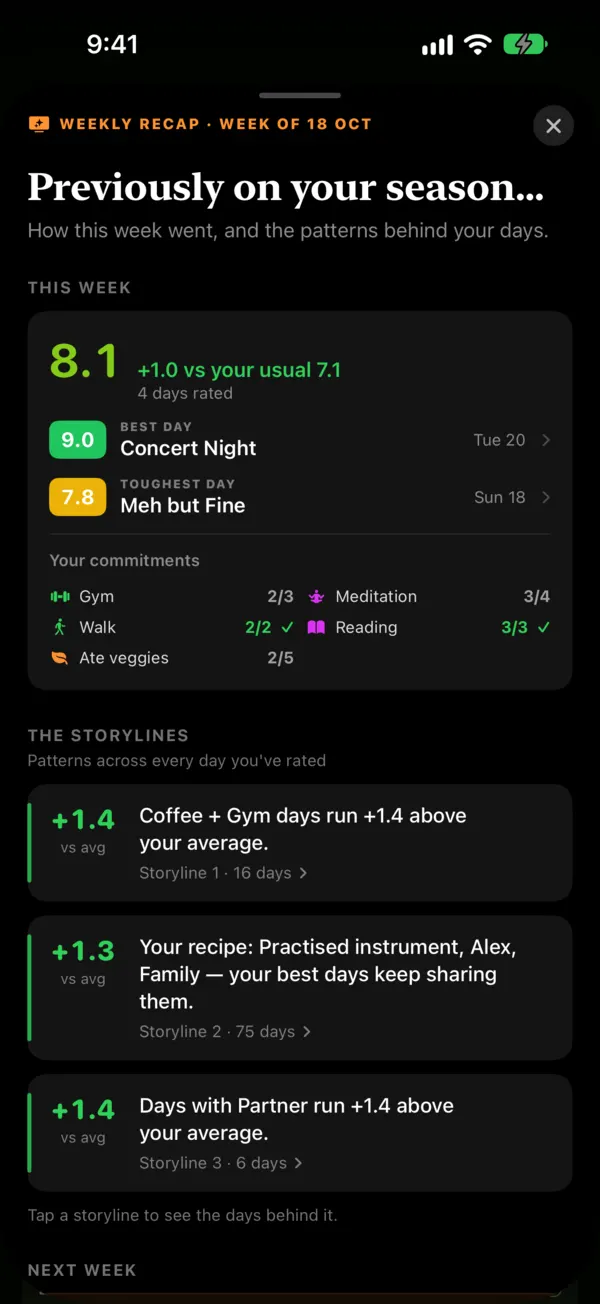
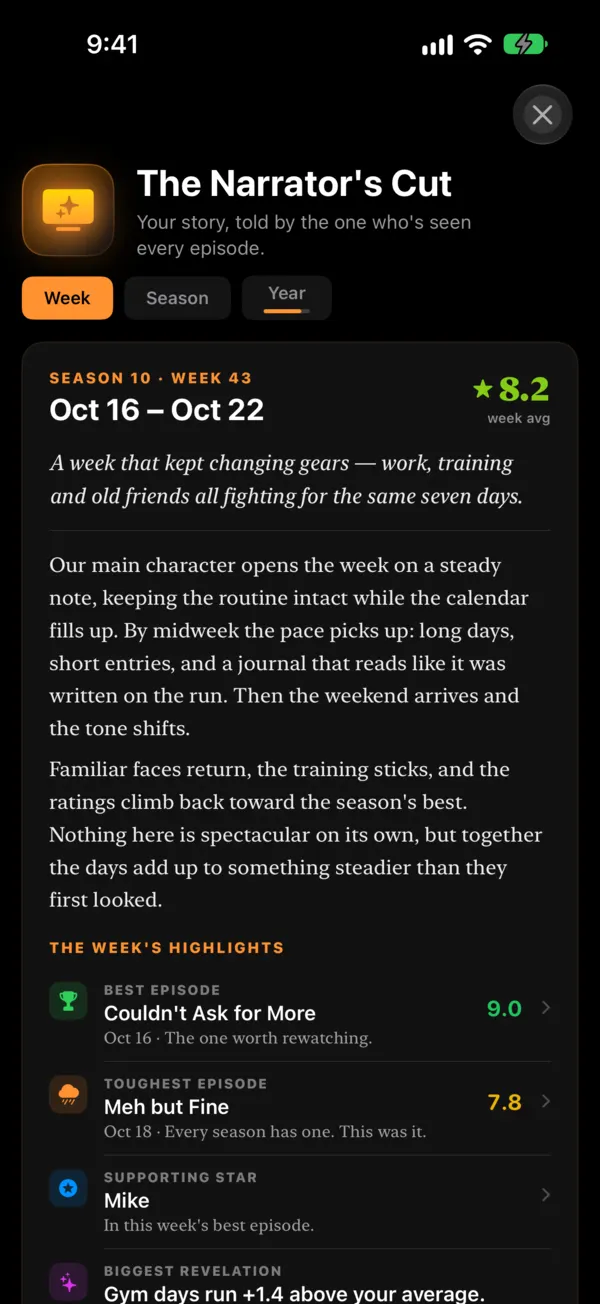
If you rate and tag your days, much of this reflection can start from a summary instead of a blank page. Rated Days writes a Narrator's Cut each week, a recap of your week told like a TV narrator, drawn from the days you rated and logged. It's a quick way to jog your memory before you answer the questions, and the tag statistics show which parts of your weeks consistently lift or drag your ratings.
Deeper weekly reflection questions
Rotate a few of these in when you have extra time, or when one area of life needs attention.
How the week felt
- If this week were a movie, what would its title be?
- How would I rate this week out of 10, and what would have made it one point higher?
- When did I feel most like myself?
- What am I still thinking about from this week?
Work and goals
- What did I plan to do versus what actually got done?
- What did I avoid, and why?
- What took longer than expected? What does that tell me?
- What progress did I make on the thing that matters most this season?
People
- Who made my week better?
- Who did I mean to contact and didn't?
- Was there a conversation I need to finish?
Health and energy
- How did I sleep, honestly?
- Did I move my body in a way I enjoyed?
- What did I eat or drink that I regret, or that helped?
Learning
- What did I learn this week, about anything?
- What would I tell myself from last Sunday?
Turning reflection into next week's plan
Reflection that doesn't change anything turns into a diary of the same complaints. Close every session with these three steps:
- Choose one change, not five. Take the answer to question 5. If you have several, pick the one with the biggest payoff.
- Make it concrete. It should say when and what: "Phone charges in the kitchen from Sunday to Thursday" rather than "less phone at night."
- Put it somewhere you'll see it. A calendar block, a phone reminder, a sticky note on the laptop.
Next Sunday, your first question is simply: did I do it, and did it help? That's how weekly reflection compounds: each week tests one small change, and over a season you keep the ones that work.
A simple weekly reflection template
Copy this into your notes app and reuse it:
- Week of: ___
- Week rating (0–10): ___
- Best moment: ___
- Hardest moment: ___
- Energy up / energy down: ___ / ___
- Repeat / skip: ___ / ___
- Last week's change, did it work? ___
- One change for next week (when + what): ___
Tips for making it stick
- Anchor it to an existing ritual, like Sunday dinner cleanup or your evening tea.
- Keep the same questions for at least a month. The repetition is what makes it quick and what makes answers comparable.
- Skip the guilt. Missed a week? Do a two-minute version next Sunday: best moment, one change.
- Review your reviews monthly. Read the last four entries together. Patterns jump out that you'd never see one week at a time. When the year ends, those notes become the raw material for a year in review.
- Use the season. If you're in the middle of a winter arc or another goal push, the weekly reflection is where you adjust the plan before it burns you out.
The short version
Every Sunday, give yourself ten minutes. Look back at each day, answer five questions with specific details, and choose one concrete change for the week ahead. Then check next Sunday whether it worked. It's a small habit, but after a few months you'll have a clear record of what makes your weeks good and fewer weeks that just disappear.
Frequently asked questions
How do you reflect on your week?
Set aside 10 minutes at the same time each week, usually Sunday evening. Look back at each day with your calendar, photos or notes, answer a few fixed questions in writing, and finish by choosing one specific change for next week. Writing the answers down matters more than how long you spend.
What are good weekly reflection questions?
Strong ones ask for specifics: What was the best moment of the week and why? What drained my energy? What did I avoid? Who made my week better? What's one thing I'll do differently next week? Avoid questions that only produce yes, no or 'fine.'
How long should a weekly reflection take?
Ten to fifteen minutes is enough for most people. Longer weekly reviews that include planning tasks and clearing an inbox can take 30–45 minutes, but if a long session is what makes you skip it, keep the reflection short and do the admin separately.
Is it better to reflect on Friday or Sunday?
Friday works well for work-focused reviews, while the week is fresh. Sunday works better for reflecting on your whole life, including the weekend, and leads naturally into planning the week ahead. Pick one and keep it consistent.