 RatedDays
The Mood Scale 1–10: What Every Number Means, and How to Keep Yours Consistent
"On a scale of 1 to 10, how are you feeling?" It sounds simple until you try to answer it every day. Is today a 6 or a 7? Was last Tuesday really a 4, or were you just tired when you logged it?
A mood scale only becomes useful when the numbers mean the same thing every time. Below is a full description for every point from 0 to 10, real example days for each, and a few habits that keep your ratings consistent month after month.
1–10 or 0–10?
Both are common. We recommend 0 to 10, for one reason: it has a true middle. On 0–10, 5 is exactly neutral. On 1–10 the midpoint is 5.5, so people split ordinary days between 5 and 6, which muddies your data.
If you already use 1–10, keep it. Consistency with your own past matters more than the perfect scale. The descriptions below work for either; on a 1–10 scale, simply merge 0 into 1.
What each number means
Read this as a starting point, then adjust the wording so it sounds like you.
0 — One of the worst days you can remember
Something seriously bad happened, or you felt as low as you've ever felt. Getting through the day was the only goal. Example: a loss, a crisis, a day you'd rather not remember.
1 — Very bad
Heavy, painful, or frightening most of the day. Very little brought relief. Example: a serious argument with someone close plus terrible news at work.
2 — Bad
Mostly hard. You functioned, but it took effort, and there was little to enjoy. Example: sick in bed, anxious, cancelled the one thing you were looking forward to.
3 — Rough
More bad than good. One or two things went wrong and colored everything else. Example: slept four hours, missed a deadline, snapped at someone.
4 — A bit below average
Not terrible, just flat or frustrating. The day felt like something to get through. Example: long commute in the rain, tedious meetings, a headache that wouldn't go.
5 — Neutral
Nothing much lifted the day and nothing much dragged it down. Forgettable. Example: worked, ate, watched something, went to bed. Fine.
6 — Decent
A little better than neutral. Something small went right. Example: a productive morning, a good lunch, an easy evening.
7 — Good
A genuinely good day you'd happily repeat. For many people this is what a good normal day looks like. Example: a workout, a nice dinner with your partner, work went smoothly.
8 — Great
Clearly above your normal. You'll still remember it in a few weeks. Example: a day at the beach with friends, or finally finishing a project you're proud of.
9 — Excellent
One of the best days of the month, maybe of the season. Almost everything clicked. Example: a birthday that went perfectly, a big personal win, a standout trip day.
10 — One of the best days of your year
Rare by design. Hold it for days that stand out across a whole year. Example: your wedding, the birth of a child, the day you got the job you wanted for years.
Quick reference
| Range | Meaning | How often (typical) |
|---|---|---|
| 0–2 | Very hard days | Rare |
| 3–4 | Below your normal | Sometimes |
| 5–6 | Ordinary days | Often |
| 7–8 | Good to great | Often to sometimes |
| 9–10 | Standouts | Rare |
"How often" is only a rough guide; your own distribution is what matters. Many people find their normal sits around 6–7 rather than exactly at 5. That's fine. It just means a 5 is a slightly flat day for you.
How to keep your mood scale consistent
The biggest problem with any mood scale is drift. Your 7 in January slowly becomes your 6 in June, and suddenly the year looks worse than it was. These habits prevent that.
Write your own anchors
Copy the descriptions above into your notes or journal, then edit each line so it sounds like your life. "7 = gym, good work day, relaxed evening" is a better anchor than "good." Reread the list whenever you hesitate between two numbers.
Rate the whole day, at the same time
Rating at 3 p.m. on some days and midnight on others mixes different things. Pick one time, usually before bed, and rate the full day rather than the last hour. Our guide to tracking your mood covers how to make that a habit.
Compare to a remembered day
When unsure, think of a recent day you rated and remember clearly. "Was today better or worse than last Saturday's 7?" Comparing to a specific day is far more reliable than judging in the abstract.
Don't rate in the heat of the moment
If you just got upsetting news or had an argument, wait 20 minutes, or rate in the morning. A single bad hour shouldn't decide a whole day's number unless it really did define the day.
Protect the ends of the scale
Keep 0–1 and 9–10 for days that actually deserve them. If you give out a 10 every other week, there's nowhere left to go when something amazing happens.
Review monthly
Once a month, look at your ratings side by side. If almost every day is a 7, you might be rounding toward a safe number. If last month's 6s look like this month's 8s, recalibrate using your anchors.
Using decimals
Decimals help when two days land on the same whole number but clearly weren't equal. A 7.2 is a good but ordinary day; a 7.8 was almost an 8.
A simple way to use them:
- .0–.3 — the low end of that number
- .4–.6 — squarely in the middle
- .7–.9 — nearly the next number up
Decide the whole number first, then fine-tune. If you catch yourself agonizing between 6.4 and 6.5, just pick one; the difference won't matter in your monthly review.
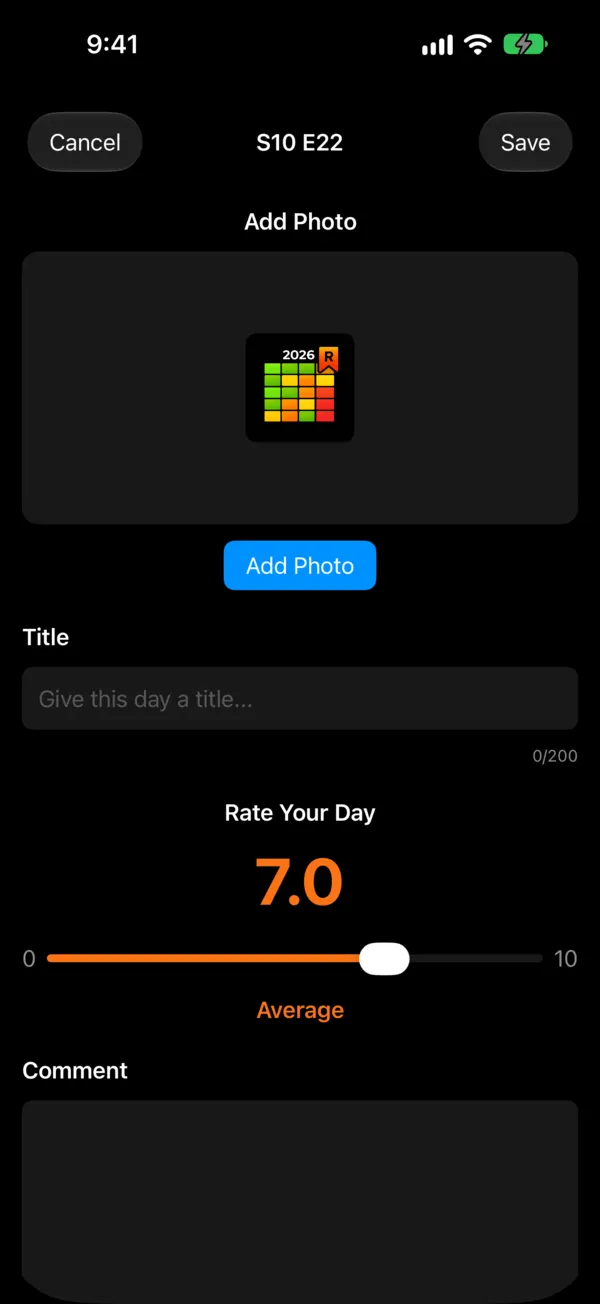
Rated Days uses exactly this kind of scale: every day is rated from 0 to 10 with one decimal on a slider, and you can tag it with what happened and who you were with, so your 7.4s and 7.8s come with context.
Example week, rated
Here's what a realistic week looks like with consistent anchors:
| Day | Rating | Why |
|---|---|---|
| Mon | 5.5 | Normal workday, tired, nothing special |
| Tue | 6.8 | Good meeting, gym in the evening |
| Wed | 4.2 | Slept badly, argument about chores |
| Thu | 6.0 | Recovered, quiet evening |
| Fri | 7.6 | Drinks with friends, laughed a lot |
| Sat | 8.4 | Hike, sunny, cooked dinner together |
| Sun | 6.3 | Errands, slight Sunday dread |
Notice the shape: the week averages about 6.4, there's one dip tied to sleep, and the best day involved being outside with people. A month of weeks like this starts showing you which kinds of days you should plan more of.
Turning numbers into colors
Once you have consistent numbers, you can color them. A common mapping:
- 0–2: dark red
- 3–4: orange
- 5–6: yellow
- 7–8: light green
- 9–10: deep green
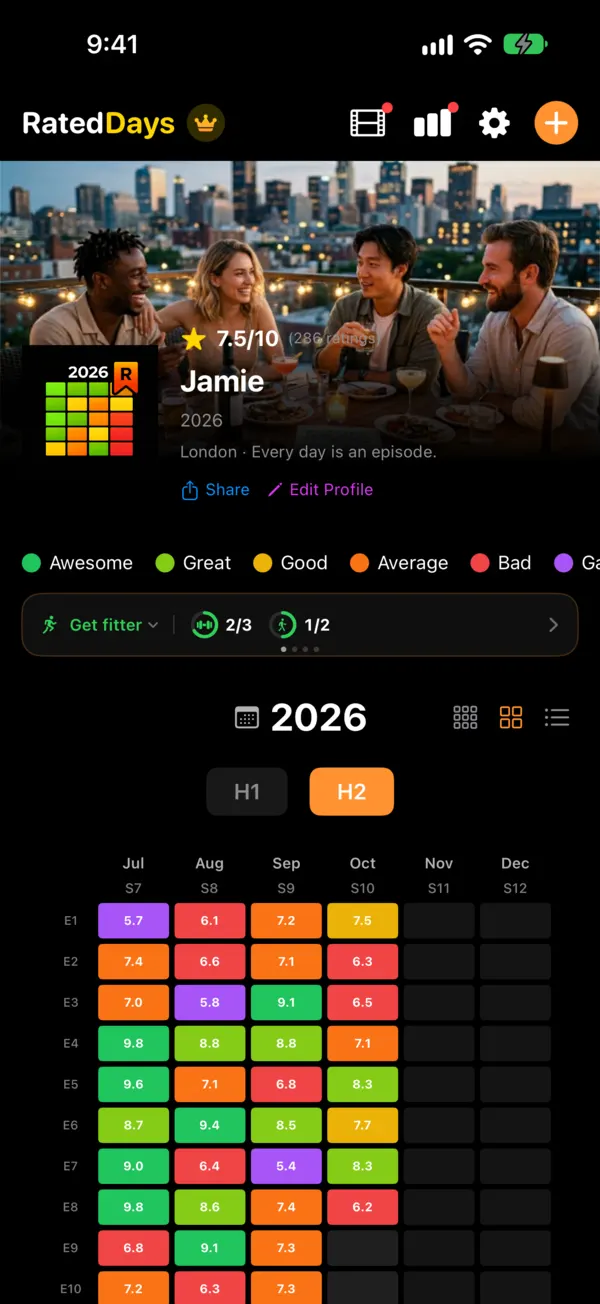
Color each day in a grid and you get a year in pixels: a full year visible at a glance. In Rated Days the home screen is that grid, and you can personalize both the colors and the rating ranges.
What the scale can't tell you
A number shows how your day went, not why. Add two or three tags (sleep, exercise, people, work) and one line of notes to each rating, and the patterns get much clearer. For more on rating days specifically, see rate your day out of 10.
And a mood scale is a self-awareness tool, not a substitute for professional help. If your ratings stay low for weeks, talk to a doctor or therapist. If you're struggling, call or text 988 (US) to reach the Suicide & Crisis Lifeline.
Frequently asked questions
What does a 5 on a mood scale mean?
A 5 is the midpoint: a neutral, ordinary day that was neither good nor bad. Nothing much lifted it and nothing much dragged it down. Many people's typical day actually lands a little higher, around 6 or 7, so a 5 is often a slightly flat day rather than an average one.
Should a mood scale start at 0 or 1?
Either works, but 0 to 10 has a true midpoint at 5, which makes neutral days easy to place. A 1 to 10 scale has no exact middle, so people tend to split between 5 and 6. Whichever you choose, keep it; switching scales breaks comparisons with your past entries.
Is it okay to use decimals when rating your mood?
Yes. Decimals help when two days feel like the same whole number but clearly weren't, such as a 7.2 and a 7.8. Use them as fine-tuning inside a number you've already chosen, not as a way to avoid deciding. Most people end up using a handful of decimals, like .2, .5 and .8.
How do I stop my mood ratings from drifting over time?
Write a one-line description for each number and reread it when unsure. Rate at the same time daily, judge the whole day rather than the last hour, and compare tonight with a recent day you remember well. Reviewing a month of ratings also shows if you've started grading easier or harder.
How often should a 10 happen on a mood scale?
Rarely. If 10 means one of the best days of your year, expect only a few. Giving out frequent 10s leaves no room above them for truly exceptional days. A good rule: if you rated more than about one day a month a 10, your scale has probably shifted upward.