 RatedDays
How to Track Your Mood (A Simple Daily Method That Actually Sticks)
Most people who start tracking their mood quit within two weeks. Not because it doesn't work, but because the method is too much: five check-ins a day, a wheel of 40 emotions, a long journal entry they don't have energy for at 11 p.m.
The method that sticks is small. One number, a few tags, one line, at the same time every day. This guide walks you through exactly that, compares the main ways to do it (apps, paper, year in pixels, a 1–10 rating), and shows you how to turn a month of entries into something you can actually use.
The 30-second daily method
Here's the whole routine. Do it once a day, ideally before bed.
- Rate the day from 0 to 10. Not your mood this second, the day as a whole. One number forces you to decide, which is the point.
- Add 2–4 tags for what happened. Short, reusable words: gym, slept badly, worked late, saw friends, rain, argument, outside.
- Write one line. What made it that number? "Long call with my sister, finally fixed the bike." That's enough.
That's it. Thirty seconds on a normal day, a couple of minutes on a big one.
Why rate the day instead of the moment
Moods change by the hour. If you log once a day at a random moment, you're mostly recording how you feel while logging, which is often tired. Rating the whole day smooths that out and gives you one comparable number per day, which is what you need to see trends.
Pick a fixed time and a trigger
The most common reason people stop is that tracking has no fixed place in their day. Attach it to something you already do:
- after brushing your teeth
- when you plug in your phone at night
- right after dinner, if you fall asleep fast
- the next morning with coffee, rating yesterday (fine, as long as you always do it that way)
Then set a daily reminder for that time. A reminder isn't a sign of weak discipline; it's the habit's scaffolding until it runs on its own.
Mood tracking methods compared
There's no best format, only the one you'll open every day. Here's how the main options stack up.
| Method | Time per day | Good at | Weak at |
|---|---|---|---|
| Mood app | 15–60 sec | Reminders, search, automatic stats | Can feel clinical; screen at bedtime |
| Paper journal / bullet journal | 2–10 min | Calm, creative, private | Hard to analyze; easy to skip when away |
| Year in pixels | 10 sec | Seeing a whole year at a glance | Little context on its own |
| 1–10 rating only | 5 sec | Fast, comparable, trendable | Says how good, not why |
Apps
Apps win on friction: a reminder pops up, you tap a number, you pick tags from a list you've already built. The big advantage shows up later, when the app can tell you that days tagged gym average a point higher than days without. Doing that by hand on paper is possible, but almost nobody does it.
Look for: a quick rating input, reusable tags, a note field, a reminder, and some kind of stats screen. Skip anything that takes more than a minute on an ordinary day.
Paper and bullet journals
Paper is slower but many people find it more pleasant, and that pleasantness keeps them going. A monthly grid with one row per day takes about ten minutes to set up. If you like drawing, it becomes a small ritual rather than a chore. For layouts and color keys, see our mood tracker ideas.
The weakness: paper rarely gets reviewed. If you go this way, put a monthly review on your calendar.
Year in pixels
A year in pixels is a grid of 365 squares, one per day, each colored by how the day went. It's the best format ever invented for answering "what was this year actually like?" You'll see the rough February, the good stretch in June, the week of the move. It works on paper or digitally; we cover setup in the year in pixels guide.
On its own it lacks context, so pair it with tags or a one-line note.
A 1–10 (or 0–10) rating
A number is the fastest possible entry and the easiest to compare over time. Its weakness is drift: is today's 6 the same as last March's 6? The fix is to write down what each number means for you, once, and check it when you're unsure. Our mood scale 1–10 guide has a ready-made description for every number.
The combination that works
The strongest setup borrows from each: a 0–10 number for comparability, tags for context, one line for memory, and a color grid for the big picture. You can do that on paper. It's quicker in an app that combines them.
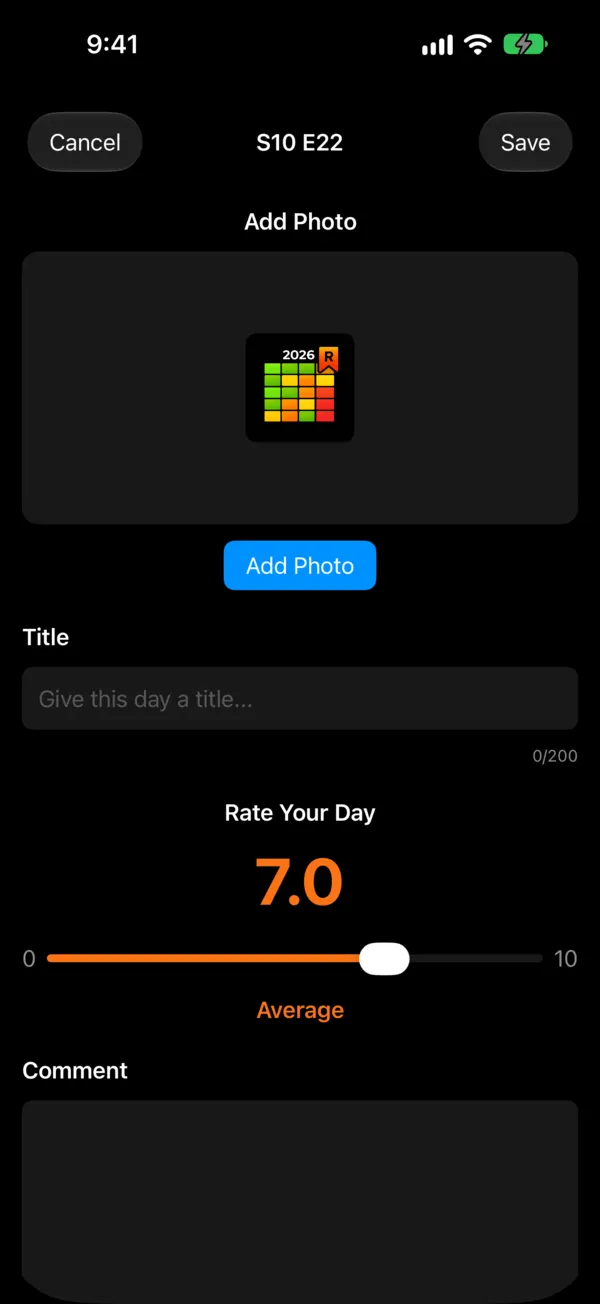
That's roughly how Rated Days is built: each day is an "episode" you rate from 0 to 10 (with one decimal, so a 7.4 is different from a 7.8), tag with what happened and who you were with, and give a short title. Your home screen shows the year as a color grid, so the pixel view fills itself in.
What to track alongside your mood
Tracking mood alone tells you how you felt. Tracking a few other things tells you why. Keep it to the ones you can actually change or that you suspect matter. Good starting tags:
- Sleep: slept well, slept badly, up late
- Movement: gym, walk, run, no movement
- People: names of the people you spent real time with, or alone all day
- Work: deadline, meetings, day off, good work day
- Outside: outdoors, sun, rain, stuck inside
- Substances: alcohol, too much coffee
- Screens: doomscrolling, phone-free evening
- Health: headache, period, sick
- Places: home, office, a café, a trip
Start with six to ten tags. You can add more when you notice something recurring ("why are Sundays always a 5?"). Too many tags at the start is the second most common reason people quit.
Consistency beats detail
Use the same words every time. gym, workout and training are three tags to a computer and three lines in your journal key. Pick one and stick to it.
How to read your mood patterns
After four weeks you have about 28 data points. That's enough for a first look. Set aside 15 minutes and go through these steps.
1. Find your baseline
What's your typical day? Sort or scan your ratings and find the middle. If most days land at 6 or 7, that's your baseline. A 5 means something different for someone whose normal is 6.5 than for someone whose normal is 4.
2. Compare your best and worst days
List your top five and bottom five days. Write the tags next to each. Patterns tend to jump out right away:
- Top five: walk, saw friends, walk, day off, slept well
- Bottom five: slept badly, deadline, slept badly, alone all day, slept badly
Here, sleep is doing most of the work. That's more useful than any amount of general advice.
3. Check the averages per tag
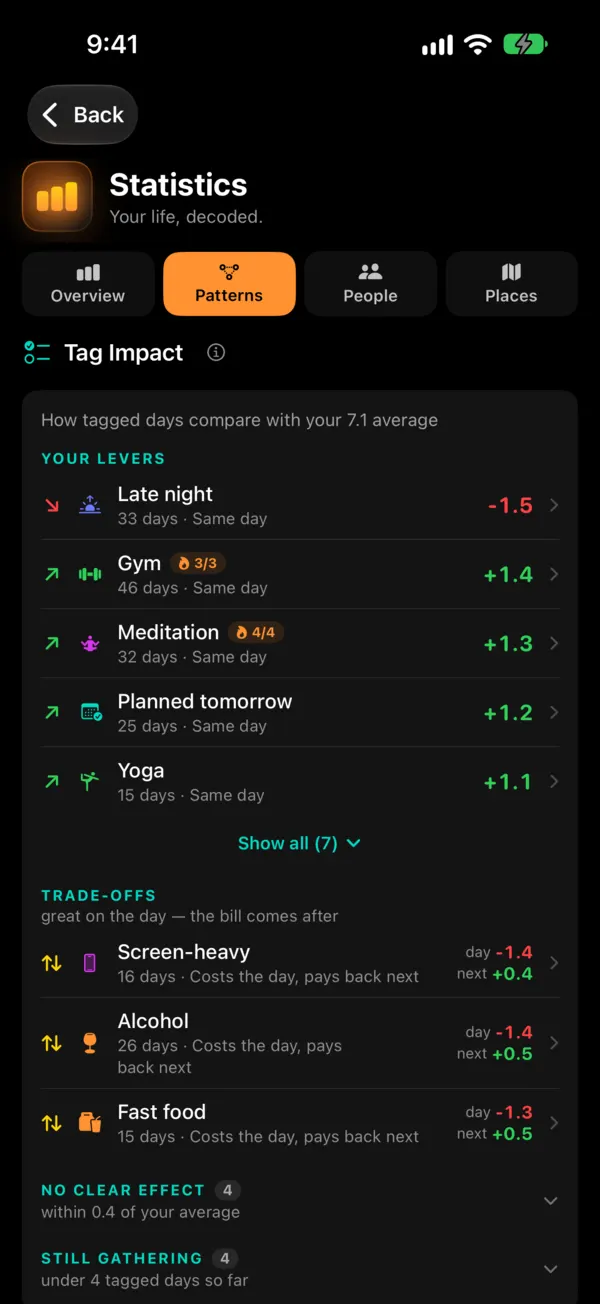
For your three most frequent tags, calculate the average rating on days with the tag and days without. If days with gym average 7.1 and days without average 6.2, that's almost a full point. On paper this takes ten minutes with a calculator; many apps do it for you.
4. Look at the shape over time
Zoom out to a month or the year. Are weekends higher? Is there a dip every few weeks? A slow slide over a month is worth noticing even if no single day looked alarming.
5. Change one thing, then check again
Pick the clearest pattern and run a small experiment: two walks a week, no phone after 10 p.m., one evening with friends. Keep tracking and compare the next month with the last. That's how tracking turns into an actual change rather than a diary of feelings.
Correlation isn't cause
A tag showing up on good days doesn't prove it caused them. Maybe you only go to the gym on days you already feel good. Treat patterns as hypotheses to test, not verdicts.
Make reviews automatic
The data only helps if you look at it. Two light reviews are enough:
- Weekly (5 minutes): What was the best day and why? The worst? Anything to repeat next week? Our weekly reflection questions make this quick.
- Monthly (15 minutes): Run the five steps above.
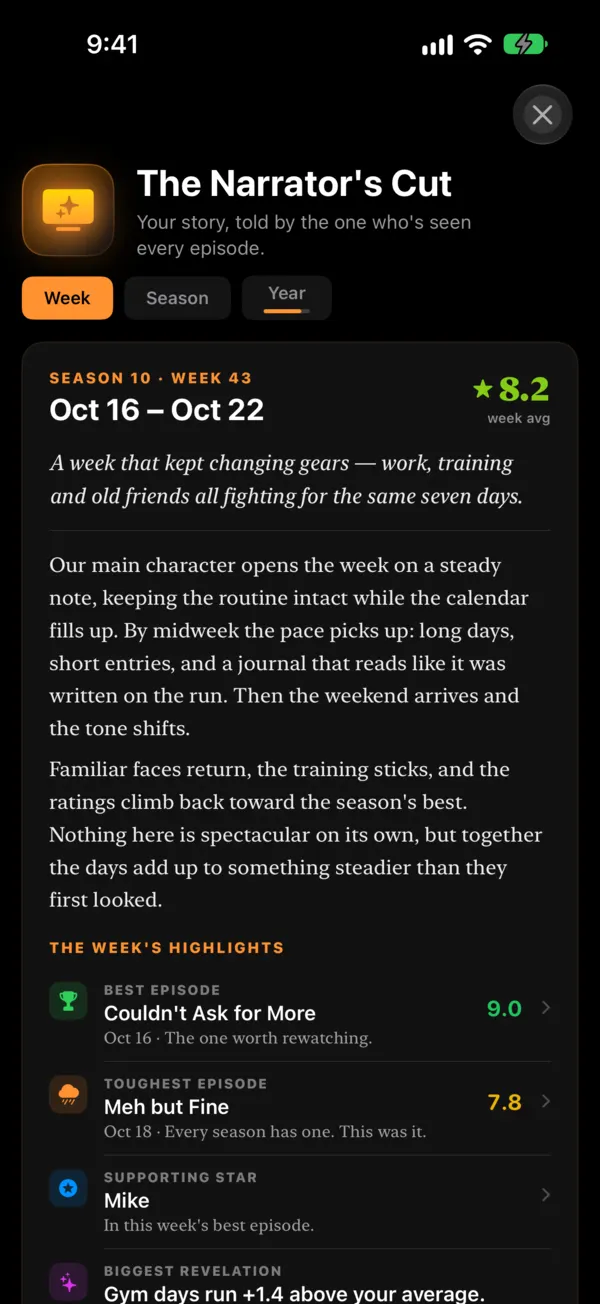
Rated Days does the first pass for you with a weekly recap (Narrator's Cut) and a monthly summary (Season Finale), plus a statistics screen showing which tags lift or drag your days. But a notebook and a Sunday-night calendar reminder do the job too.
Common mistakes (and quick fixes)
- Tracking too much. Five moods, ten emotions, sleep hours, water, steps. Cut back to a number, tags and a line.
- Rating while upset. If you just had an argument, wait 20 minutes or rate in the morning.
- Never reviewing. Book the monthly review now.
- Quitting after a missed day. Missed days are normal. Fill in yesterday if you remember it, leave it blank if not, and carry on.
- Only logging bad days. Log every day. The good days are what show you what works.
A note on mental health
Mood tracking is a self-awareness tool, not a diagnosis or treatment. It isn't a substitute for professional help. If your tracker shows a long run of low days, bring it to a doctor or therapist; a few weeks of real entries makes that conversation easier. If you're struggling or thinking about harming yourself, call or text 988 (US) to reach the Suicide & Crisis Lifeline.
Start tonight
You don't need a perfect system. Tonight, before bed, write down a number from 0 to 10, two or three words for what happened, and one sentence. Do the same tomorrow. In a month you'll know more about what shapes your days than any quiz could tell you.
Frequently asked questions
What is the best time of day to track your mood?
For most people, the evening works best because you can judge the whole day instead of a single moment. Tie it to something you already do every night, like brushing your teeth or plugging in your phone. If evenings are chaotic, rate yesterday first thing in the morning instead, and stick with that choice.
How often should you track your mood?
Once a day is enough for general self-awareness and is far easier to sustain than several check-ins. Logging many times a day can turn into constantly monitoring yourself. If a doctor or therapist asks you to track more often, for example morning and evening, follow their plan instead.
How long does it take to see patterns in mood tracking?
You can spot obvious things, like bad Mondays, within two to three weeks. Reliable patterns, such as how much exercise or a certain person lifts your rating, usually need four to eight weeks of daily entries. Seasonal patterns take a full year, which is where a year-in-pixels view helps.
Is a mood tracking app better than a paper journal?
Neither is better in general. Paper is calmer and more creative but harder to analyze. An app is faster, reminds you, and can calculate which habits line up with better days. Pick the one you are most likely to open every single day; consistency matters more than the format.
What should I do if my mood tracker shows mostly low days?
Take it seriously rather than just logging it. Show your tracker to a doctor or therapist, since a few weeks of real data makes that conversation easier. If you are struggling or having thoughts of harming yourself, call or text 988 in the US to reach the Suicide & Crisis Lifeline.