 RatedDays
The One Line a Day Journal: The Smallest Habit That Actually Sticks
A one line a day journal asks you for exactly one sentence about your day. That's it. No prompts you have to answer, no pages to fill, no "Dear Diary."
It sounds too small to matter. But it's the journaling format people most often keep up for years, and the reason is in the size. Here's how it works, what makes a good line, and how to choose between a paper journal and an app.
What is a one line a day journal?
It's a diary with a hard minimum and a soft maximum: every day, you write at least one line about that day. Most people write it in the evening, in under a minute.
The best-known version is the five-year journal: a book with one page per calendar date, each split into five short slots. In year one you fill the top slot. In year two you write in the second slot, right under what you wrote on the same date a year ago. By year five, each page holds five versions of the same day stacked on top of each other.
You don't need that specific book. The habit is the point. Any notebook, a notes app or a journaling app works.
Why the tiny format works
It removes the two reasons people quit. Most journals die from time ("I'll write tonight, properly") and perfectionism ("this entry has to be good"). One sentence takes 30 seconds and nobody expects it to be good.
Missing a line is cheap. A skipped day in a long-form journal feels like a debt. A skipped line is just a blank line. That makes it easier to restart.
It forces you to choose. With only one sentence, you have to ask: what actually mattered today? That small act of choosing is a form of reflection. Long entries often just retell the schedule.
The value compounds. One line is forgettable. 365 lines are a year you can reread in fifteen minutes. You'll find things you'd completely forgotten: a friend's offhand joke, the week you were obsessed with a song, the day a worry quietly disappeared.
How to start a one line a day journal
- Pick one format and stop shopping. Notebook, five-year journal or app. Decide today; you can switch later.
- Attach it to an existing habit. Right after brushing your teeth, right before you put your phone on the charger, on the train home. A daily reminder helps for the first few weeks.
- Date every line. Sounds obvious, but undated lines lose most of their value when you reread them.
- Write the most specific thing. One concrete detail beats a summary. (Examples below.)
- Add a mood score if you like. A 0–10 number next to each line turns your journal into a mood record too. See how to rate your day out of 10 for a simple scale.
- Reread monthly. At the end of each month, read the whole month. It takes two minutes and it's the part that makes the habit feel worth it.
Examples of good one-liners
The difference between a line you'll treasure and one you'll skim past is specificity. Compare:
| Vague | Specific |
|---|---|
| Good day at work. | Finally shipped the project; my manager said "this is clean" and I've thought about it all evening. |
| Saw Mom. | Mom taught me her lentil soup; she doesn't measure anything, so I wrote "a handful" six times. |
| Tired. | Slept 5 hours, survived on two coffees, fell asleep on the couch at 8:40. |
| Nice weekend. | First cold morning of the year; walked to the bakery in a scarf and it felt like a movie. |
More examples, by the kind of day:
Ordinary days
- Took the long way home because the light was nice. Worth the extra 10 minutes.
- New neighbor introduced herself. Her dog is called Biscuit.
- Ate lunch outside for the first time since March.
- Found $5 in last winter's coat.
Good days
- Got the job. Called Dad from the parking lot before I even started the car.
- Six of us around a table too small for four, nobody wanted to leave.
- First time running 5K without stopping. Legs are jelly.
Hard days
- Argument with J about money. Neither of us was really talking about money.
- Bad news from the doctor's office; waiting for more tests. Scared.
- Nothing went wrong, everything just felt heavy.
Days that turned around
- Awful morning, but a stranger let me go ahead at the pharmacy and that reset it.
- Missed the train, ended up having coffee with an old colleague on the platform.
Notice that the hard-day lines are honest without being long. That's one of the quiet strengths of the format: it lets you record a bad day without having to process it on the spot.
If you get stuck, keep a few one-sentence questions handy: "What was the best ten minutes?" "What will I remember from today?" "What surprised me?" You'll find more short ones in our daily journal prompts.
The episode title: a one-liner with a twist
Here's a variation worth trying: instead of describing the day, title it like an episode of a TV show.
- "The One Where the Car Wouldn't Start"
- "Lentil Soup, Unmeasured"
- "Biscuit Moves In Next Door"
- "Survival Mode"
A title is even shorter than a sentence, and it's easier to recall. It also nudges you to find the day's story, which makes rereading more fun.
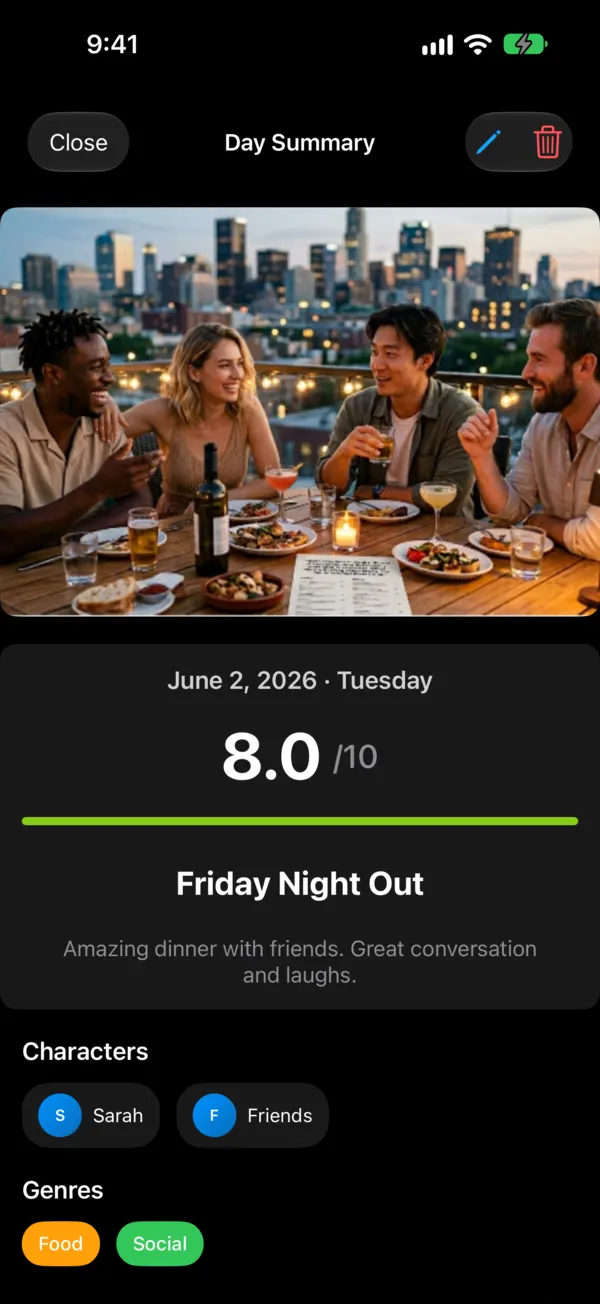
This is how Rated Days works. Each day is an episode (November 3 is S11 E3), you rate it from 0 to 10, and you give it a title. If you want more, you can add a note, photos, tags, the people you were with and where you went, but the title and the rating are enough.
Paper vs app: which is better?
Both work. The best one is the one you'll open tomorrow. Here's the honest trade-off:
A paper journal (or five-year book) is great if you:
- Like a screen-free moment before bed
- Enjoy seeing your handwriting change over time
- Want the five-year "same date, stacked" view without any setup
- Don't mind that it can't be searched and only lives in one place
An app is great if you:
- Always have your phone but rarely a pen
- Want a reminder, a home screen widget or a quick way to log from the lock screen
- Want to search old entries ("when did we go to that lake?")
- Want to see patterns: which days were best, which habits or people show up on your good days
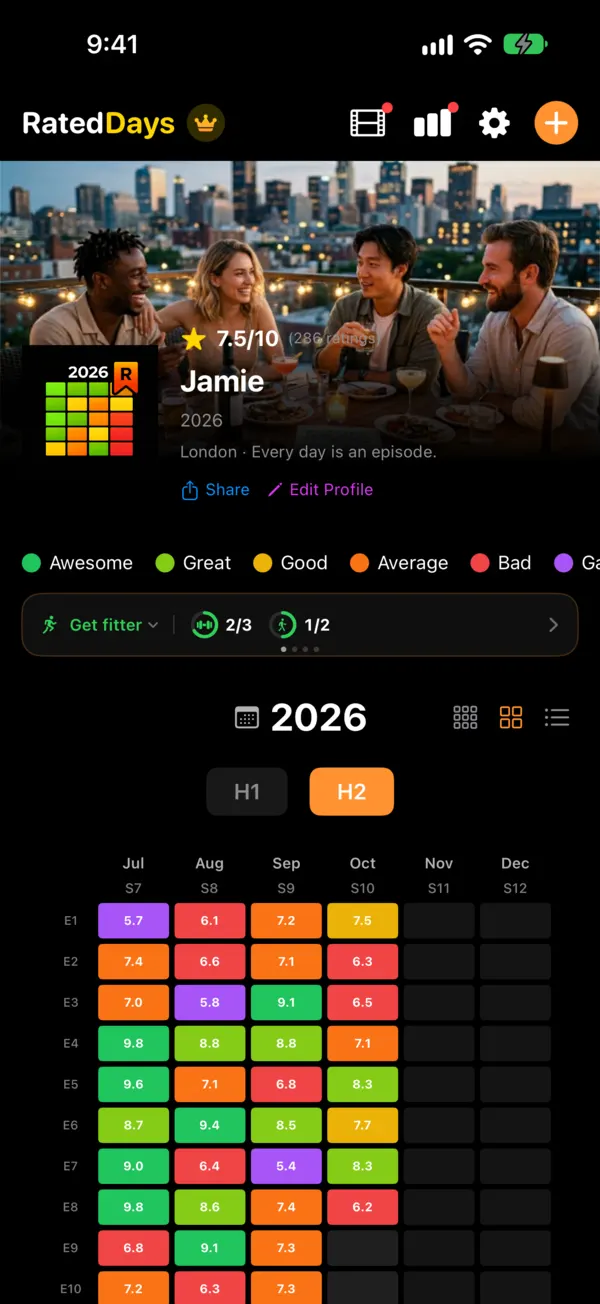
The pattern part is where apps pull ahead. In Rated Days, every rated day becomes a colored square on a year in pixels grid, so a year of one-liners also becomes a picture of your year. Weekly and monthly recaps (Narrator's Cut and Season Finale) summarize what happened, and search lets you find any day by title, tag, person or place.
Some people do both: a paper line at night for the ritual, a quick rating in an app for the patterns. That's fine too.
Tips for keeping it going past month two
- Lower the bar on bad weeks. A single word is still an entry. "Flu." counts.
- Don't backfill a week from memory. Write today's line and move on. Gaps are part of the record.
- Reread around the one-year mark. Reading what you wrote on this date last year is the moment most people get hooked for good.
- Keep it private by default. If you write as if someone will read it, you'll start performing. Write for future you.
One sentence a day is about 365 sentences a year, roughly the length of a short story. It just happens to be about you.
Frequently asked questions
What do you write in a one line a day journal?
Write the one detail from the day you'd most want to remember: something that happened, something someone said, or how the day felt. Specific beats general. 'Fixed the leaky tap myself, watched a video twice' will mean more in a year than 'Productive day at home.'
Can I write more than one line?
Yes. The one line is the minimum, not a limit. On big days, write more. The point of the format is that a busy or flat day still counts, so you never have a reason to skip. Many people find the tiny commitment is what makes longer entries happen.
What if I miss a day?
Fill it in tomorrow if you remember, or leave it blank and write today's line. Don't try to catch up a whole week from memory; those entries tend to be vague. One gap doesn't break the journal. Quitting because of one gap does.
Is a five-year journal the same as a one line a day journal?
Most five-year journals are one line a day journals. Each page holds one date with five short slots, one per year, so from year two you see what you wrote on the same date last year. You can keep the same habit in any notebook or app without that layout.